

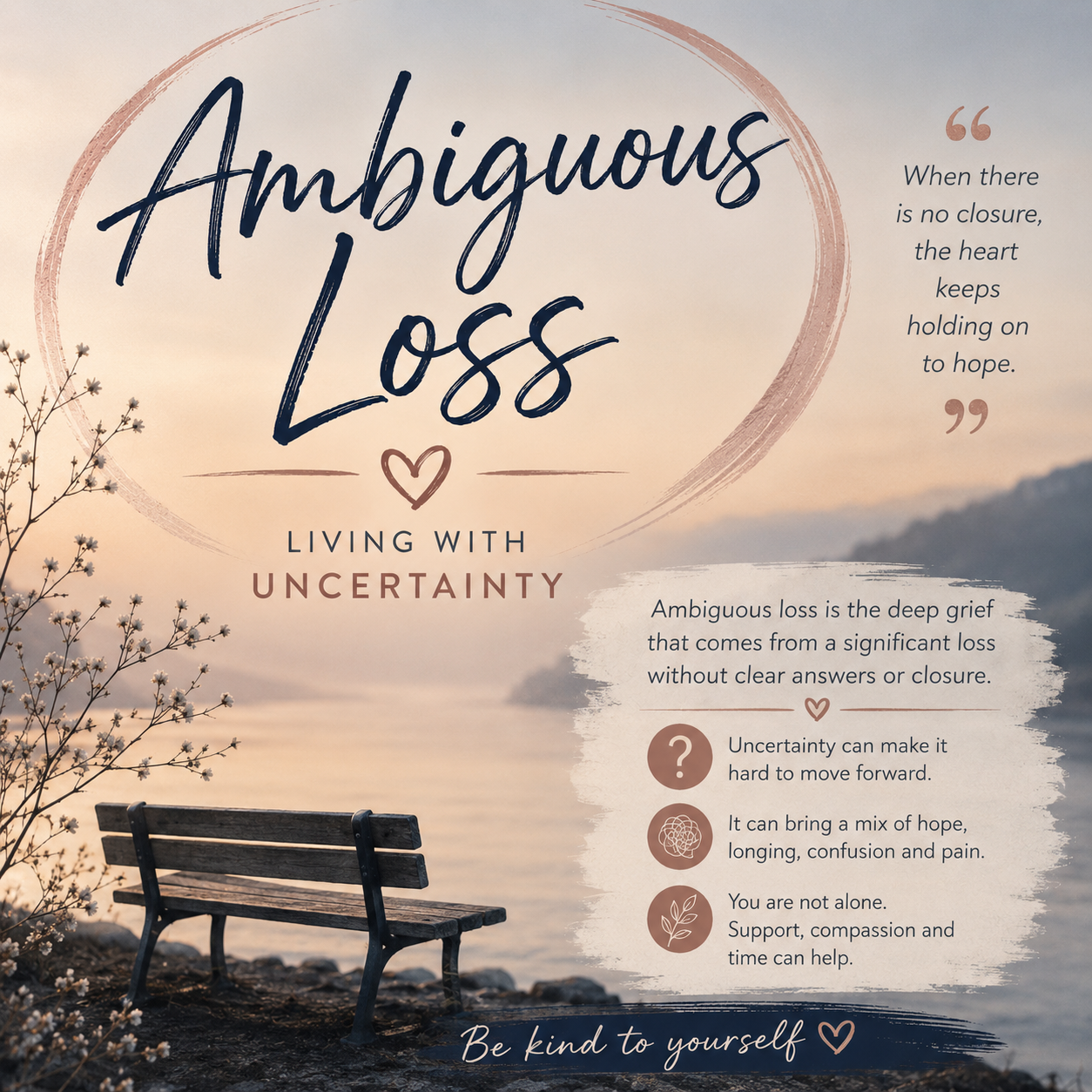
Ambiguous Loss: Living with Uncertainty
Have you ever felt the loss of someone who is still alive?
Or perhaps you've experienced the uncertainty of not knowing whether a relationship will ever return to what it once was.
If so, you may have experienced what is known as ambiguous loss.
Unlike bereavement, where there is a clear ending, ambiguous loss is defined by uncertainty. It can leave us with unanswered questions, changing roles, and a sense of living in limbo.
What is ambiguous loss?
There are two types of ambiguous loss.
Physically present but psychologically absent
The first occurs when someone is physically present but psychologically absent. This is commonly seen in people living with degenerative conditions such as dementia.
As dementia progresses, there may be a gradual decline in memory, thinking, communication and everyday functioning. Someone may become confused, agitated, or struggle to recognise familiar people and places. Over time, additional medical, emotional and practical support may become necessary.
For family members, this can change the relationship they once knew.
Questions may begin to arise, such as:
- Am I now a husband, wife, son, daughter…or a carer?
- Do they still recognise me?
- How can I best support them?
- What will life look like in six months or even five years' time?
The uncertainty surrounding these changes can create a profound sense of loss, even though the person is still physically present.
Physically absent but psychologically present
The second type of ambiguous loss occurs when someone is physically absent but remains psychologically present in our minds.
We may continue thinking about them, wondering how they are, imagining conversations, questioning why things happened, or hoping circumstances may change.
Examples may include:
- A missing person
- Long-term estrangement
- Divorce or separation where the future remains uncertain
- Situations involving prolonged uncertainty within important relationships
This type of loss may also involve the absence of emotional, practical or financial support that the person once provided.
Although they are no longer physically present, the relationship continues psychologically.
What about geographical separation?
People often ask whether living apart from someone automatically creates ambiguous loss.
Not necessarily.
Simply living in another town, city or country isn't ambiguous loss because there is usually certainty. You know where they are and can often maintain contact.
However, if someone became unreachable or went missing, uncertainty enters the relationship. It is this uncertainty that creates the ambiguity.
A real-life example may be families of armed forces personnel during deployment. Although they know why their loved one is away, there may still be uncertainty about where they are, when they will next make contact, or when they will return home. The relationship changes, bringing both separation and uncertainty.
Why isn't bereavement considered ambiguous loss?
This is a question many people ask.
Following a death, someone is physically absent but remains psychologically present through memories, thoughts and love.
However, bereavement is not generally considered ambiguous loss because there is certainty. Although incredibly painful, there is a recognised ending to the person's life.
Both bereavement and ambiguous loss can bring grief, sadness, anger, confusion, guilt, loneliness and frustration.
The difference is that bereavement has certainty, whereas ambiguous loss is defined by uncertainty.
I would also like to acknowledge that some deaths can leave unanswered questions or circumstances that are difficult to understand. If this reflects your own experience, my thoughts are with you.
Why is ambiguous loss so difficult?
Healing from ambiguous loss does not necessarily mean achieving complete closure.
Instead, it often involves learning to live alongside uncertainty.
That can be much easier to say than to do.
Because the person may still be alive, others may not recognise or validate your sense of loss. There are often no rituals, such as funerals or memorial services, that acknowledge what you are experiencing.
Many people describe feeling caught between hope and acceptance.
Hope that things might improve.
Frustration that nothing feels certain.
A feeling of remaining in limbo.
My own reflections
When I first came across the term ambiguous loss, I honestly didn't understand it.
My first thought was:
"If I lose my mobile phone, is that ambiguous loss?"
After all, I wouldn't know whether I'd ever see it again!
I quickly realised I'd completely misunderstood the concept.
Ambiguous loss isn't about losing possessions.
It's about the uncertainty surrounding significant relationships and how those relationships can change over time.
The loss isn't simply of the person.
It can also be the loss of familiarity, connection, shared roles and the relationship as you once knew it.
Although, if you've lost your phone because your AI assistant is on it, don't panic! Simply log in on another device. There may even be a future podcast exploring artificial intelligence in the counselling room, so stay tuned.
Learning to live with uncertainty
One of the leading researchers in this area, Dr Pauline Boss, suggests that healing doesn't always come from finding answers.
Instead, it can come from learning how to live alongside uncertainty.
This doesn't mean giving up hope or pretending everything is okay.
It means accepting that, for now, some questions may never have clear answers.
Looking after yourself remains important.
That might include:
- Spending time with family and friends.
- Enjoying hobbies.
- Volunteering.
- Exercising.
- Joining a support group.
- Making time for yourself.
Doing these things doesn't mean you've forgotten the person.
It means you're continuing to care for your own wellbeing while learning to live with uncertainty.
Final thoughts
Ambiguous loss is often an invisible form of grief.
Because there is no clear ending, it can feel confusing, isolating and difficult to explain to others.
If this blog has resonated with your own experiences, I hope your thoughts and feelings have felt seen, heard and validated today.
If you would like to learn more, there are organisations dedicated to supporting people affected by ambiguous loss, including the Ambiguous Loss website, which offers further information and resources.
Thank you for taking the time to read this month's blog.
Take care, and until next time.
Disclaimer
This blog is intended for general reflection and understanding. The views shared are based on my experiences as an online private practice counsellor and are not intended to replace individual counselling or professional advice.