
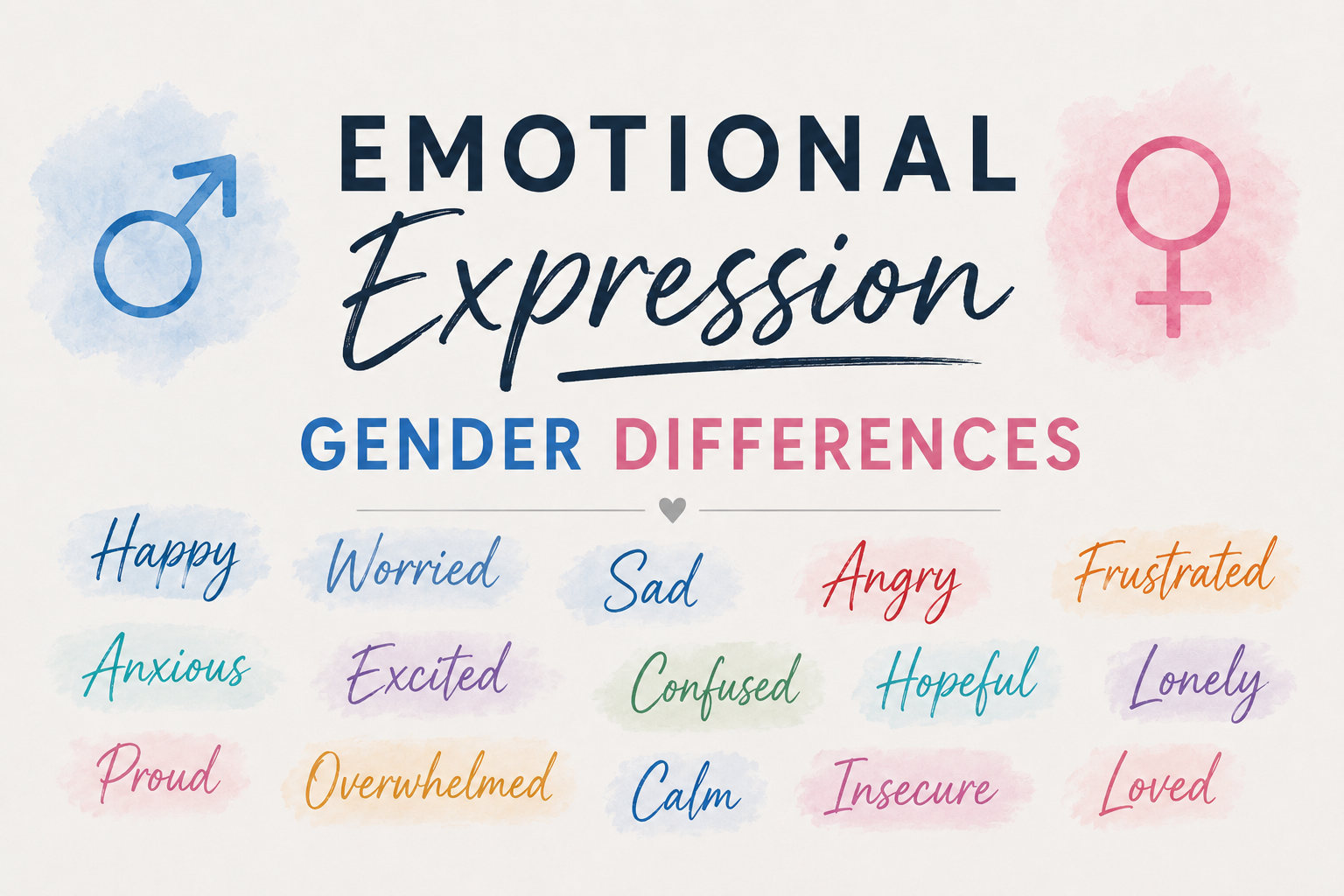
Emotional Expression: Gender Differences
Have you ever stopped to wonder why some people seem comfortable expressing their emotions while others appear more reserved?
Is it personality? Life experience? Or could it be that many of us have grown up with unconscious beliefs about how men and women are "supposed" to express themselves?
These are the questions that inspired this month's blog.
Where do our beliefs come from?
The ability to communicate our needs begins from the moment we are born. As we grow, our thoughts, feelings and beliefs are influenced by our experiences, the people around us, and the messages we receive from society.
Throughout history, gender roles have often shaped expectations of emotional expression.
Television dramas such as Upstairs, Downstairs, Downton Abbey and Bridgerton portray different social expectations and gender roles. Although they are dramatisations and may not always be historically accurate, they highlight how women were often expected to marry, raise children and support the family, while men were expected to provide, lead and remain emotionally strong.
Although society has changed significantly, some of these historic assumptions can still influence how we view ourselves and others today.
A slice of carrot cake and an unexpected reflection
The inspiration for this topic came from a quiet afternoon with a cup of coffee, a slice of carrot cake (which I decided counted as one of my five-a-day!) and a little people-watching.
I noticed a young man and woman sitting together, who I assumed were getting to know each other.
The woman appeared confident, expressive, humorous and engaged. She maintained strong eye contact and naturally led the conversation.
The young man listened carefully, smiled, laughed at the right moments, but appeared quieter and more nervous.
As I watched them, I began to wonder...
What if their behaviour had been reversed?
What if the man had been the confident, expressive one while the woman sat quietly, appearing nervous and allowing him to lead the conversation?
Would I have interpreted the situation differently?
Would I have assumed she was uncomfortable?
Would I have considered intervening?
The answer surprised me.
I realised that I, too, had unconsciously absorbed some of society's assumptions about gender and emotional expression.
Thankfully, I resisted introducing myself to tell them they'd inspired my next podcast. Apparently, that would have been a little strange! But they certainly gave me something to reflect upon.
How quickly do we make assumptions?
Imagine you're in a supermarket or café.
You notice one person crying while another comforts them.
Without thinking too much...
Who did you picture crying?
If it was a man being comforted by a woman, would your initial reaction be different?
If it was the other way around, would you think something else entirely?
There isn't necessarily a right or wrong answer.
The important part is becoming aware of the assumptions we naturally make.
Now consider your own life.
If you openly expressed your emotions today, how do you think those around you would respond?
Would you feel comfortable?
If not...why?
Emotional expression in the counselling room
Our early experiences influence how we communicate, build relationships and express ourselves emotionally.
For some people, expressing emotions feels safe and natural.
For others, it may feel unfamiliar, uncomfortable or even risky.
When emotional expression has not been encouraged, people may learn that keeping their feelings inside feels safer than sharing them.
This can lead to misunderstandings within relationships.
One person may wonder:
- Why won't they talk to me?
- Why can't they tell me how they're feeling?
- If they don't express emotion, do they even care?
Meanwhile, the other person may be thinking something very different:
- I do care—I just show it differently.
- Why do I have to be emotional?
- What does emotional vulnerability even look like?
- Men don't cry.
- I need to stay strong.
- I have responsibilities.
- I don't have time to fall apart.
Neither perspective is necessarily wrong.
They are often shaped by different experiences, beliefs and expectations.
Challenging old beliefs
Sometimes we continue to live by the beliefs we learned growing up.
Sometimes we challenge them.
Sometimes we change them altogether.
The counselling room offers a space to gently explore where these beliefs came from and whether they continue to serve us.
Rather than saying:
"Why won't you talk to me?"
or
"Why can't you express yourself?"
it may be more helpful to say:
"I know expressing yourself isn't always easy. Take your time."
Creating a safe environment can make emotional expression feel possible rather than pressured.
Are gender assumptions still present today?
Think about these professions:
- Car mechanic
- Doctor
- Hairdresser
- Nail technician
- Farmer
Did you automatically picture a particular gender?
There is no right or wrong answer.
The question simply encourages us to notice how historical expectations can continue to influence our thinking, often without us realising it.
Although society has evolved and opportunities have become far more equal, cultural, social and generational influences can still shape our perceptions.
Final thoughts
This blog is not about suggesting one gender should express emotions more openly than another.
Nor is it about encouraging every man to suddenly become emotionally expressive.
Instead, it is about recognising that every person has a unique story.
By understanding where beliefs about emotional expression may have originated, we can begin to have more compassionate conversations, reduce assumptions and create space for people to communicate in ways that feel authentic to them.
The more informed we are, the more understanding we can become—both of ourselves and of those around us.
Thank you for taking the time to read this month's blog.
Disclaimer
This blog is intended for general reflection and understanding. The views shared are based on my experiences as an online private practice counsellor and are not intended to replace individual counselling, medical advice or other professional support.