

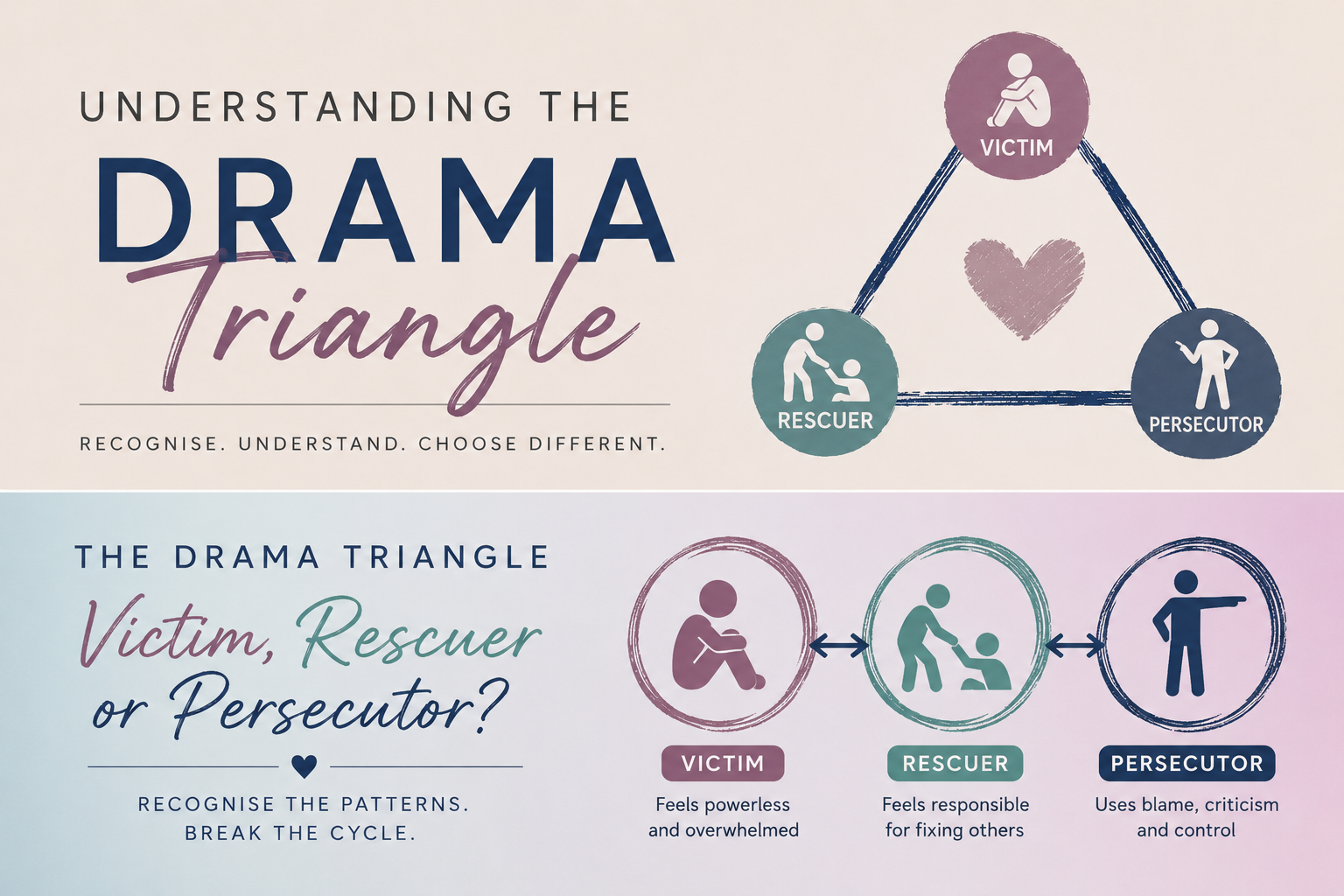
Understanding the Drama Triangle: Why We Can Find Ourselves Switching Roles
Have you ever walked away from a conversation wondering how everything changed so quickly?
Perhaps you began by trying to help someone, only to end up feeling frustrated. Maybe you've felt powerless in a situation, or found yourself becoming critical of someone despite not wanting to.
These changing patterns of interaction are described in a psychological model known as The Drama Triangle, developed by Stephen Karpman in 1968.
The Drama Triangle isn't about labelling people as good or bad. Instead, it helps us understand the roles we can unconsciously move between when we feel stressed, overwhelmed or emotionally triggered.
The three roles are:
- The Victim
- The Rescuer
- The Persecutor
One of the most important things to remember is that we can move between all three roles, sometimes within the same conversation.
The Victim
Within the Drama Triangle, the Victim role is not about someone who has experienced abuse or trauma, although they may have.
Instead, it describes someone who feels powerless, overwhelmed or unable to change their current situation.
They may think things such as:
- "Nothing ever works out for me."
- "There's nothing I can do."
- "Nobody understands."
- "Why does this always happen to me?"
People in this role often struggle to see possible solutions because their emotional distress makes change feel impossible.
Many people don't consciously choose this role. It may develop after experiences of criticism, feeling unheard, unsupported or powerless, where believing they had no control became the safest way to cope.
The Rescuer
When someone we care about is struggling, our natural instinct is often to help.
The Rescuer genuinely wants to reduce another person's distress and may offer practical help, advice or emotional support.
You may recognise phrases such as:
- "Don't worry, I'll do it."
- "Let me help."
- "You don't need to do this alone."
- "I just want what's best for you."
There is nothing wrong with supporting others.
However, difficulties can arise when helping becomes taking over.
The Rescuer may gradually become responsible for solving problems that don't belong to them, sometimes putting their own wellbeing, time and boundaries aside.
If their efforts don't create the outcome they hoped for, frustration can build.
This is often where the next role appears.
The Persecutor
The word "Persecutor" can sound harsh, but within the Drama Triangle it doesn't mean someone is abusive or a bad person.
Instead, it describes how stress, fear or frustration can sometimes be expressed through criticism, blame or attempts to regain control.
They may say things like:
- "You never listen."
- "Why can't you just do it properly?"
- "This is your fault."
Underneath these reactions there is often anxiety, hurt, disappointment or exhaustion.
Sometimes criticism is simply the outward expression of emotions that have not been communicated in healthier ways.
How We Move Around the Triangle
One of the reasons this model is so helpful is that it reminds us these roles are not fixed.
We can move between them depending on the situation.
For example:
A colleague feels overwhelmed at work and says they can't manage their workload.
You offer to help and stay late to finish their work.
Over time, your help becomes expected rather than appreciated.
Eventually you feel resentful and say,
"I can't keep doing this for you."
You have moved from Rescuer into Persecutor.
Your colleague now feels criticised, loses confidence and begins to think they aren't capable.
They move into the Victim role.
The cycle continues.
Similar patterns can develop within families, friendships and romantic relationships, often without anyone intending harm.
Self-awareness rather than blame
One reason I enjoy talking about this topic is because I recognise these patterns in myself too.
When technology refuses to cooperate, I can very quickly move into feeling completely incapable.
Someone kindly offers to help.
If the problem isn't solved immediately...
...I can become rather impatient!
It makes me smile now because understanding the Drama Triangle has helped me recognise my own reactions instead of simply blaming the computer (although occasionally I still think it's the computer's fault!).
Counselling training also helped me understand why I naturally spent much of my life in the Rescuer role, and how constantly solving other people's problems wasn't always healthy for either of us.
How counselling can help
Understanding the Drama Triangle isn't about trying to become perfect or making sure you never find yourself in one of these roles again.
Instead, it offers an opportunity to become more aware of your own thoughts, feelings and behavioural patterns.
In counselling, we can explore:
- why certain situations trigger particular roles
- where these patterns may have developed
- how they affect your relationships
- how greater self-awareness can create different choices moving forward
Often, the goal isn't changing who you are.
It's understanding yourself with greater compassion.
Once we begin to recognise our patterns, we also create the opportunity to respond differently.
Further reading
If you'd like to learn more about the Drama Triangle and related psychological concepts, you may find these resources helpful:
Books
- Games People Play
- The Body Keeps the Score
- Attached
- Adult Children of Emotionally Immature Parents
Podcasts
- Dr Julie Smith
- Esther Perel
- Brené Brown
Trusted organisations
- Mind
- NHS
- BACP